Living Verse · Language Arts
Language Arts the Way It Was Designed to Be Taught
Modern education complicated language arts, and generations of students never learned to write. We made it simple and beautiful again.
Poetry · Scripture · Literature · Ages 6 to 14
One book, everyone together, each working on their own level.

5.00 out of 5, across every review
Charlotte Mason · 28 weeks · Ages 6–14 · Lessons and student notebook in one volume
Why Living Verse
They Complicated Language Arts
Drills. Worksheets on similes versus metaphors. Grammar taught in a vacuum, disconnected from anything a child would ever actually write.
Generations of students went through all of it and still couldn't write.
We simplified it.
One living passage at a time. Grammar, vocabulary, punctuation, and literary devices learned inside beautiful writing instead of apart from it. Everything connects. Nothing feels random or out of context.
And here is what we discovered.
Every child can write beautifully.
"I'm an editor and a published author. I know Living Verse works. It actually teaches a child to write. All the other programs are disconnected from real writing and language usage."
— Editor, author & homeschool mom
Choose your year
Three Volumes. One Method.
Each is a full 28-week curriculum built on Charlotte Mason's time-tested methods. Each puts the instructional lessons and the student notebook in one simple-to-use volume. Each is written for ages 6 to 14.

Living Verse
Language Arts in Poetry
Because language arts should be simple, beautiful and fun.
Twenty-eight weeks of poets and poems, and thirty-six language and poetry elements learned inside them. Your children will study, mark, interpret, recite, and finally write poetry of their own.

Living Verse
Language Arts in Scripture
Because writing should be learned from the pinnacle of all written language.
A new genre of Scripture each month, drawn from both the Old and New Testaments. Your children will mark its structure, copy it, imitate the way it was written, and hide it in their hearts.
Living Verse
Language Arts in Literature
Because the best writing teachers a child will ever have are the books on the shelf.
The same method, brought to prose. Your children will study passages from the finest literature, learn the elements that make them beautiful, and model that writing in their own.

Volume I · Poetry
Living Verse Language Arts in Poetry
Because language arts should be simple, beautiful and fun.
Living Verse unwraps the gift of poetry. Your children will reach new heights in intellectual culture and language development. They will become stronger thinkers, stronger speakers, and stronger writers as they discover and model the language elements that create one of the oldest and most beautiful forms of writing.
28 weeks · 4 days a week · 36 language & poetry elements
What it teaches
Every element, learned inside a poem
- grammar
- vocabulary
- punctuation
- figurative language
- poetic structure
- poetic artistry
- critical thinking
- critical reading
- reading fluency
- speaking fluency & articulation
- creative expression
- narration
- dictation
- handwriting
- spelling
Each week
What your children will do
- Meet a new poet and study his or her poems
- Experience and create visual narrations of the poems
- Recognize rhyme schemes through marking the poems
- Identify the structure of the poems
- Learn new vocabulary contained in the poems
- Discover the language arts and poetic devices used in the poems
- Interpret and reflect on the message of the poems
- Copy portions of the poem
- Creatively express the poems through writing and recitation
- Model the poems by composing original poetry
- Celebrate the poets with illustrations, written narrations, and tea time

Look inside
A week with Mary Howitt


Click any page to enlarge.
A uniquely integrated language arts and poetry curriculum. It creates a culture of joy, curiosity and beauty. And it brings families closer.
Buy Living Verse Poetry"I have been teaching language arts in public, private, and online schools for the past decade. I've never used a curriculum that is so enjoyable and thorough. I love that it pulls everything together. It is not fragmented the way that so many programs are."
— Classroom teacher of ten years

Volume · Scripture
Living Verse Language Arts in Scripture
Because language arts and writing should be learned from the pinnacle of all written language, the holy Scriptures.
The Scriptures are the most beautiful writing ever set down. Why teach a child to write from anything less?
Living Verse Scripture creates a culture of beauty, inspiration, curiosity and a love for God's Word in children ages 6 to 14. Your family's heart and mind will be transformed as you come to know the treasures of God's Word more deeply.
28 weeks · Old & New Testament · A new genre each month
What it teaches
Every element, learned inside the Word
- grammar
- vocabulary
- punctuation
- language usage
- literary devices
- critical thinking
- critical reading
- reading fluency
- speaking fluency & articulation
- creative expression
- narration
- handwriting
- Scripture memory

Each week
What your children will do
- Encounter a new genre of Scripture each month, from an Old and New Testament passage
- Experience and create visual narrations of the Scripture
- Identify and mark the structure of the Scripture
- Learn new vocabulary
- Discover the language arts and language devices used in the Scripture
- Interpret and reflect on the Scripture's meaning
- Copy portions of the Scripture to train grammar, punctuation, spelling and writing
- Model the Scripture by imitating the way it was written
- Express the Scripture through illustrating it or writing a reflection about it
Look inside
Sample pages


Click any page to enlarge.
The instructional lessons and student notebook come in one simple-to-use volume, sure to become a treasured keepsake.
Buy Living Verse ScriptureComing Spring 2027
Living Verse Language Arts in Literature
Because the best writing teachers a child will ever have are the books on the shelf.
The third volume brings the same method to prose. Your children will read passages from the finest literature, mark what makes them work, learn the words and devices the author chose, and then write that way themselves.
Same 28 weeks. Same four short days a week. Same one volume holding both the lessons and your child's notebook.
"My daughter loves this. I never thought she would enjoy poetry. She looks forward to this every day. Poetry and cursive are her 'fun' subjects now."
— Homeschool mom
A living education
Why Families Choose Living Verse
✦Everything connects
Grammar, punctuation, and literary devices are learned inside real writing. Nothing feels random or out of context.
✦Short, gentle lessons
Four days a week, a few minutes at a time. Short enough to never become a burden, and children ask for it.
✦The Charlotte Mason method
Narration, copywork, dictation, and notebooking. The proven way children actually learn language and remember it.
✦One book, every age
Written for ages 6 to 14, so your children can work through it together, each responding at their own level.
✦Open and go
Lessons and student notebook in a single volume. Nothing to print, nothing to prepare, nothing to piece together.
✦It teaches writing
Children don't just label a metaphor. They write one. Every week ends with your child composing something of their own.
Where do I begin?
Which Volume Should We Start With?
You can't pick wrong. The volumes aren't a sequence, so you don't finish one to earn the next. Start with either of the two available now.
If your family wants to fold language arts into your Bible time, start with Scripture. One study, two purposes, and the words your children copy are the words you most want them to carry.
If your children are new to poetry, or if someone in your house has decided they don't like language arts, start with Poetry. It's the gentler doorway. Poems are short, they're beautiful, and a child who resists a grammar worksheet will sit still for a poem about a spider and a fly.
And you can use them both. Many families run Poetry one year and Scripture the next, or alternate them across two children. The method is the same, so nothing has to be relearned. Literature joins them in the spring of 2027.
What it looks like day to day
Four days a week, a few minutes a day
How Long Does a Lesson Take?
Most days, ten to fifteen minutes. The lessons are deliberately short. Mothers tell us the same thing again and again: their children asked when it would be time for poetry, and the lesson ended before anyone got tired of it.
Four days a week for twenty-eight weeks. That's the whole plan.
How Involved Is Each Lesson?
Your child reads the poem or the passage. Then, depending on the day, you'll be given one of the following:
- A marking activity, where your child finds the structure or the rhyme scheme
- A vocabulary or language-device discovery
- A narration prompt, spoken, written, or drawn
- Copywork or dictation from the passage
- A creative composition, where your child writes something of their own
There is nothing to prepare. Everything your child needs is printed in the book, on the page you're already open to.
What Ages Is It For?
Ages 6 to 14. A six-year-old will narrate out loud and draw. A fourteen-year-old will mark the structure, write the reflection, and compose original verse from the same poem on the same page.
Teach them together from one book. That is the point of a living education.
A book he will keep
The Living Verse Notebook
Living Verse cultivates the expression of your child's own living ideas. It uses notebooking, a method that is time-tested, effective and enjoyable.
The written and visual narration prompts spur creativity. They bring forth your child's unique thoughts in words and illustrations.
As your child records his learning in the beautiful Living Verse notebook, he'll be authoring a one-of-a-kind volume. Something he can be proud of and treasure forever.


5.00 out of 5 · 9 reviews
What Families Are Saying
"I have been teaching language arts in public, private, and online schools for the past decade. I've never used a curriculum that is so enjoyable and thorough! I love that it pulls everything together. It is not fragmented the way that so many programs are. I love the gentle approach to literary terms and punctuation. I love the space for the imagination, drawing, and internalizing the poetry. It's beautiful and deep. My daughter loves it."
Classroom teacher of ten years
"My daughter loves this. I never thought she would enjoy poetry. She looks forward to this every day. Poetry and cursive are her 'fun' subjects now. Thank you again!"
Verified buyer
"I have been homeschooling for 7 years now with kids ages 8 to 13. I can finally say I love working together in this Living Poetry Book. I have boys too, and they normally aren't excited about language arts or poetry. Now they are really enjoying writing and poetry."
Natalie
"The quality is EXCELLENT. The pages are thick and sturdy and the cover is beautiful. Inside the book is filled with really wonderful imagery to compliment the poetry. There is also a real picture of each poet as you introduce the new poem. It's worth every penny."
Jillian
"The art and layout of the pages was so beautiful and not overwhelming! The instructions were clear and gentle."
Wendy
"I came to this site looking for more products because we have loved this so much. My 8-year-old daughter and I enjoyed this immensely."
Stella

From my classroom to yours
Why I Wrote Living Verse
Shiela Catanzarite is an author, speaker, editor, and communication coach. She's a 20-year Charlotte Mason veteran homeschooler. For 15 years she has worked as Jeannie Fulbright's editor and designer, helping develop Jeannie's award-winning Apologia science curriculum and the Charlotte Mason products published through Jeannie Fulbright Press.
She earned a bachelor's degree in Special Education and a master's degree in Christian Education from Dallas Theological Seminary, and she has been teaching language arts in some capacity for 40+ years. Her passion remains helping students understand the elements of language and how to use those elements artfully. Today she works one-on-one as a Language Communication Coach with students who have language learning and communication challenges. She also writes curriculum for her private middle and high school English Language Communication classes.
Shiela and her husband Bruce have two daughters. Both attended private universities on scholarship and went on to graduate studies in medicine and global business. Shiela attributes their love for learning and academic achievement to homeschooling with Charlotte Mason's philosophy and methodology.
"Poetry is, perhaps, the most searching and intimate of our teachers."
— Charlotte Mason
Start this week
Your child can write beautifully.
Read a free sample of either volume, or order the one your family will open on Monday morning.
Living Verse Language Arts in
Poetry
Because language arts should be simple, beautiful and fun.
Living Verse unwraps the gift of poetry while helping children reach new heights in both intellectual culture and language development. Your students will become stronger thinkers, stronger speakers, and stronger writers as they discover and model the language elements that create one of the oldest and most beautiful forms of writing.
A 28-week full curriculum that cultivates the understanding and usage of grammar, vocabulary, punctuation, figurative language, poetic structure, poetic artistry, critical thinking, critical reading, reading fluency, speaking fluency and articulation, creative expression, narration, dictation, handwriting, and spelling.
A uniquely integrated language arts and poetry curriculum that creates a culture of joy, curiosity and beauty while bringing families closer. Instructional lessons and student notebook are offered in one simple-to-use volume, developed for students ages 6 to 14.
Give your children a whole book, living language arts experience as they learn 36 language and poetry elements using Charlotte Mason's time-tested methods of learning. Through the 28 weeks of lessons your children will meet a new poet and study his or her poems, create visual narrations, mark rhyme schemes, identify structure, learn new vocabulary, discover poetic devices, interpret the message, copy portions of the poem, express the poems through writing and recitation, compose original poetry, and celebrate the poets with illustrations, written narrations, and tea time.
Living Verse Language Arts in
Scripture
Because language arts and writing should be learned from the pinnacle of all written language, the holy Scriptures.
Living Verse Language Arts in Scripture creates a culture of beauty, inspiration, curiosity and a love for God's Word for children ages 6 to 14.
A 28-week full language arts and writing curriculum that cultivates the understanding and usage of grammar, vocabulary, punctuation, language usage, literary devices, critical thinking, critical reading, reading fluency, speaking fluency and articulation, creative expression, narration, handwriting, and Scripture memory.
The instructional lessons and student notebook are offered in one simple-to-use volume that is sure to become a treasured keepsake. Your family's heart and mind will be transformed as you come to know and experience the treasures of God's Word more deeply.
Through these time-tested methods of learning your children will encounter a new genre of Scripture each month from an Old and New Testament passage, create visual narrations, identify and mark the structure, learn new vocabulary, discover the language devices used, interpret and reflect on the meaning, copy portions to train grammar, punctuation, spelling and writing, model the Scripture by imitating the way it was written, and express it through illustration or written reflection.

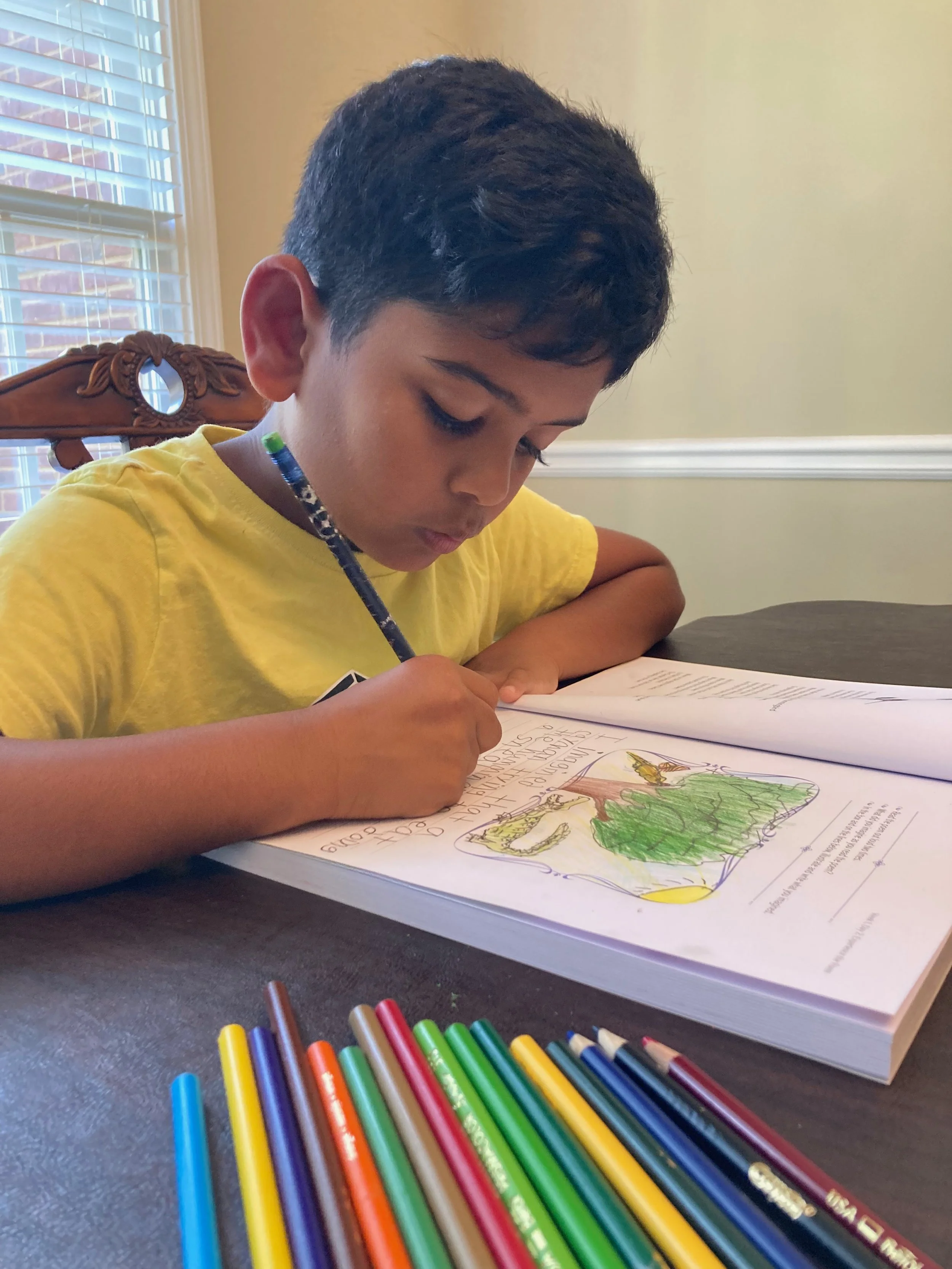
“My children liked the gentle start of our day, which made our other lessons easier.”
“They were proud of their work when they realized they could come up with their own metaphors.”